
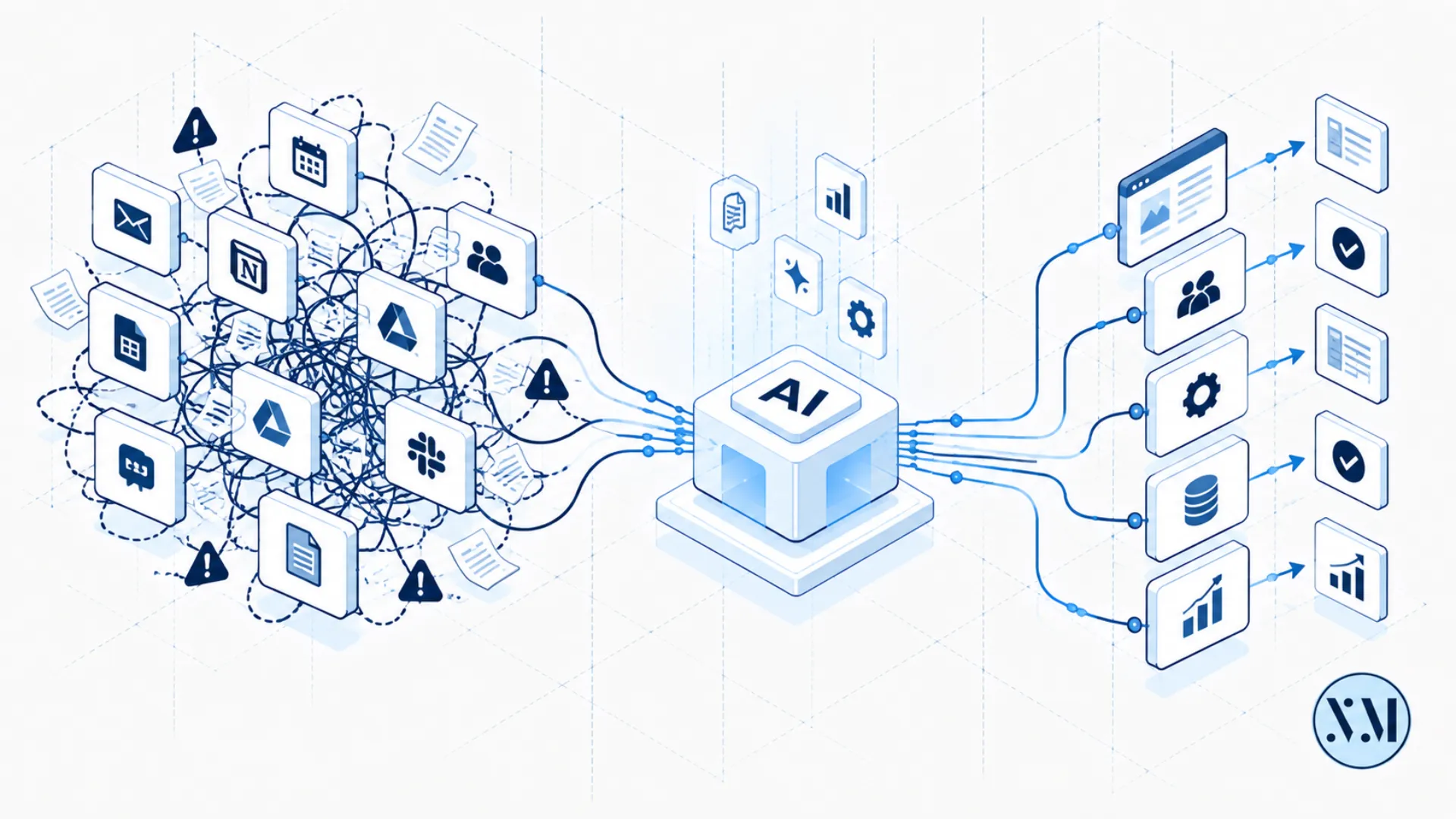
AI Should Make Your Business Simpler, Not More Complicated
AI is most useful when it solves a real business problem. Before adding it to your workflow, understand where it can reduce effort without introducing unnecessary complexity.

AI is now being added to almost every conversation about business technology.
Customer support.
Marketing.
Sales.
Research.
Operations.
Internal knowledge.
Software development.
The opportunity is real.
So is the temptation to add AI simply because it exists.
Start with the problem
The wrong question is:
"Where can we use AI?"
The better question is:
"Where does the business currently spend time on work that could be improved with AI?"
That distinction keeps AI practical.
AI is useful where information is abundant
AI can be particularly useful when people need to:
- summarize information
- classify requests
- extract structured data
- draft routine material
- search large bodies of information
- identify patterns
- transform information from one format to another
These are useful capabilities.
But usefulness depends on the process surrounding them.
Do not automate uncertainty
If nobody understands a process, adding AI will not magically make it clear.
An AI system still needs:
- useful inputs
- defined objectives
- appropriate permissions
- clear outputs
- human oversight where necessary
- failure handling
The business should understand the process before delegating parts of it.
Keep humans where judgment matters
A customer complaint may contain information an automated system can summarize.
That does not mean a machine should automatically decide how the business responds.
A proposal may be drafted with AI.
That does not mean it should be sent without review.
AI can reduce effort without eliminating responsibility.
Consider the operational cost
Every AI workflow introduces questions.
What data does it receive?
Where does that data go?
Who can access it?
What happens when the output is wrong?
Who monitors it?
What happens when the provider changes?
How much does it cost at scale?
These are not reasons to avoid AI.
They are reasons to implement it thoughtfully.
AI should remove complexity
A useful test is simple:
After introducing AI, is the business easier to operate?
If the answer is no, reconsider the implementation.
The objective is not to have AI everywhere.
The objective is to reduce unnecessary effort and improve the quality of work.
That is a much more durable strategy.